
2026 CitrusBeat: June irrigation decisions shape harvest outcomes

Across California citrus this June, orchards are moving through one of the most important sizing windows of the season, Stage II fruit development, when cell enlargement drives final fruit size after the earlier cell division phase has set the potential. At this point, fruit growth is accelerating.
ET demand is climbing fast. In many blocks, the difference between steady sizing and stalled growth comes down to how stress is avoided through heat events and irrigation gaps. Most growers already know the challenge: The season rarely falls apart from one big mistake. It’s usually small periods of stress that quietly compound over time.
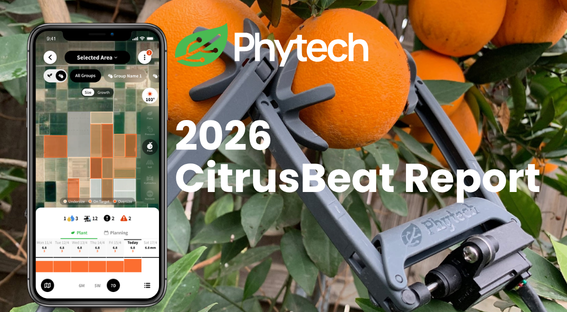
2026 CitrusBeat report , let's grow!
Information provided by Phytech’s Head of Agronomy, Ziv Attia, PhD
Fruit sizing momentum
By the time fruit size becomes a concern at harvest, the opportunity to influence it is mostly gone. June and July are where a lot of sizing is gained or lost. Growers using continuous fruit growth monitoring are able to see whether fruit is still gaining size steadily after irrigation events, heat spikes, and changing ET conditions instead of waiting for visual signs later in the season.

Heat response across different soil types
With temperatures climbing, variability between blocks becomes more noticeable. Some ranches are seeing heavier soils stay wet too long while lighter ground begins falling behind between sets. In many orchards, irrigation schedules that looked fine in May are no longer keeping pace with June demand. Plant response combined with soil moisture trends can help identify where irrigation timing is drifting before stress starts affecting fruit growth.

Keeping water in the active root zone
One of the biggest challenges during summer irrigation is not simply applying enough water, it’s keeping water where the tree can actually use it. Too shallow - and trees cycle into stress faster between irrigations. Too deep - and water moves below the active root zone, increasing pumping costs and reducing efficiency. The growers getting ahead of summer pressure are paying close attention to how water is moving through the profile, not just total runtime.

Managing more acres with fewer eyes in the field
Good farming still comes from good people in the field.
Phytech simply helps identify where attention is needed first — whether it’s a block falling behind on moisture, uneven irrigation movement, or fruit sizing slowing after a heat event. We’re not replacing boots on the ground, and the goal is not to replace experience. It’s to help experienced teams react faster and catch issues earlier.
For example, the hydraulic view helps crews understand how water is actually moving through the system, making it easier to spot pressure drops, uneven distribution, or irrigation performance issues before they show up in the field. On top of that, NDVI adds another layer of visibility, helping confirm canopy uniformity across the ranch so managers can quickly see where blocks are lagging or responding differently under the same program. Together, it’s about connecting what the system is doing with what the trees are showing, so decisions in the field are faster, more targeted, and more consistent.
At the end of the day, citrus profitability is still driven by the fundamentals:
consistent sizing, distribution uniformity, water use efficiency, and avoiding unnecessary stress during key growth periods.
The growers who stay ahead of these details through June and July are usually the ones in the best position heading into harvest.


Simple birthday wishes can sometimes feel more genuine than long messages filled with complicated or overly emotional language.
The June irrigation decisions discussed in 2026 CitrusBeat: June irrigation decisions shape harvest outcomes highlight an important idea: good outcomes often depend on paying attention to small factors early. Just as citrus growers consider water, timing, soil conditions, and plant needs before harvest, understanding neurological and developmental conditions also benefits from a step-by-step approach. Interestingly, both topics remind us that individual circumstances matter, and that thoughtful decisions can make a meaningful difference over time.
This connects naturally to adhd symptoms, where recognizing patterns rather than focusing on one isolated behavior can provide a clearer picture. Attention difficulties, forgetfulness, impulsivity, restlessness, and problems with organization may affect everyday activities in different ways. Looking at when symptoms occur, how long they have…
The discussion of irrigation decisions in 2026 CitrusBeat is a good reminder that timing, preparation, and consistent follow-through can have a major effect on long-term results. Interestingly, the same idea applies to e-commerce marketplaces. Bringing shoppers to a platform is important, but the marketplace also needs the right sellers and enough useful products to give those shoppers a reason to stay.
This connects directly with Seller acquisition for an e-commerce marketplace. Rather than trying to sign up every possible business, I would first look at where customers are seeing gaps. If certain categories have limited choices or popular products are missing, those areas can guide seller outreach. Retailers, manufacturers, wholesalers, independent brands, and local businesses may all be useful depending…
These cursed images made me question everything I thought I knew about reality. Absolutely unhinged and hilarious at the same time.
Check them out here: cursed images
This is a really useful tool for turning a standard home printer into a poster-making machine. I love the idea of printing out a huge mural in sections and assembling it myself—perfect for classroom projects or spicing up a blank wall without paying for expensive large-format printing. The concept is simple but so effective, and it makes big visual ideas way more accessible. Definitely worth a try if you're into DIY decor: rasterbator